
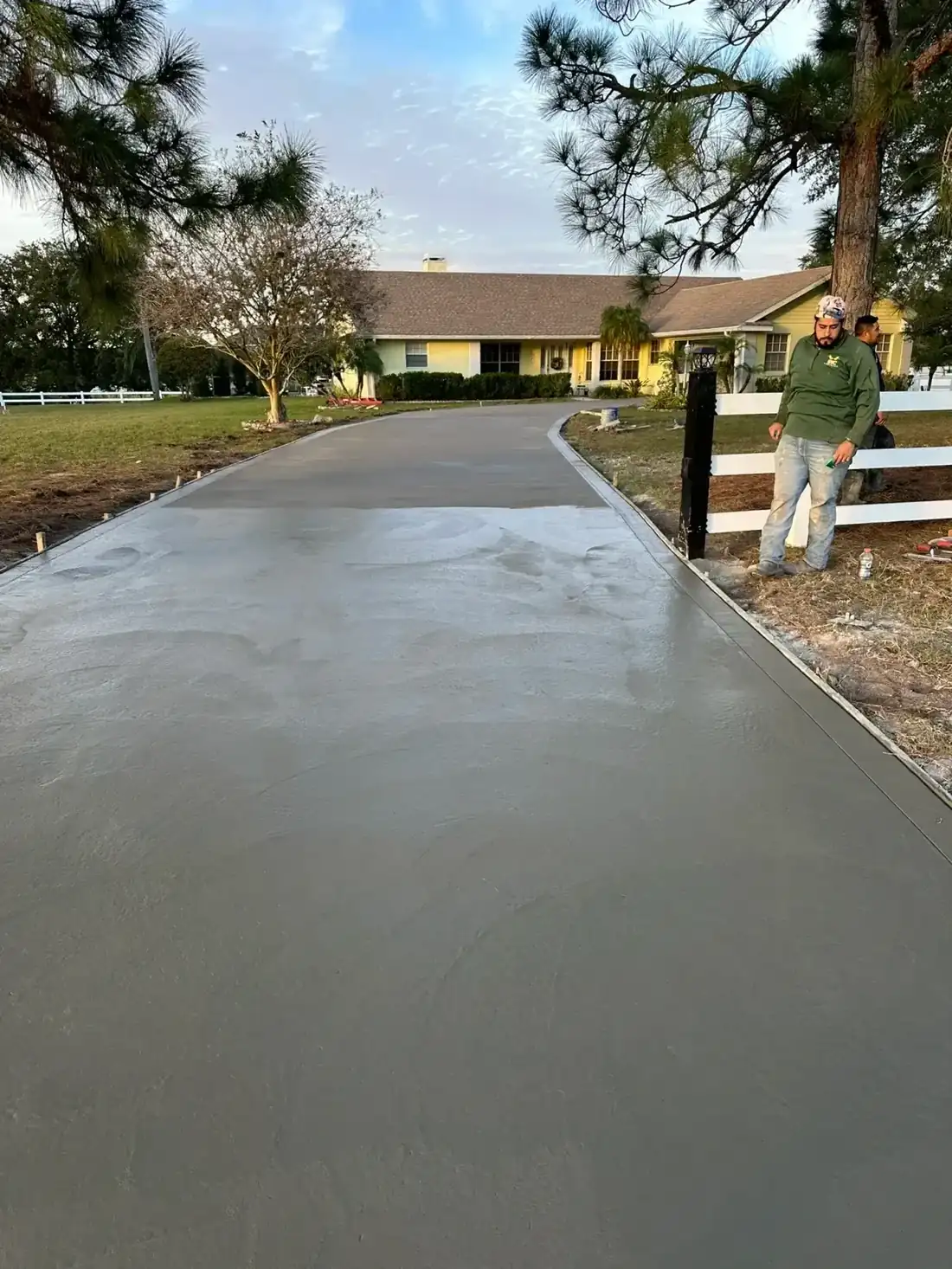
What The Colony requires before concrete driveways get poured
The city's Do I Need a Permit? sheet keeps this simple: any installation, extension, repair or replacement of a driveway or approach takes a permit. That covers a full tear-out. It also covers a one-car widening and a single broken panel that gets cut out and repoured. On the FY 2026 fee schedule, the flatwork permit is $50, and staff also collect a separate $50 non-refundable application fee before they process anything. File after the pour and the fee doubles.
Everything is submitted digitally as PDF files only. Expect Building Inspections to take 10 to 15 business days on a plan review, so get the permit on the calendar well ahead of the truck. City code adds a rule for contractors: anyone who has to pull a permit needs a current city registration before doing excavation or concrete flatwork. Our permit guide for the north Dallas suburbs lines The Colony up next to Frisco, Plano and Lewisville. While the paperwork is moving, request a free estimate.
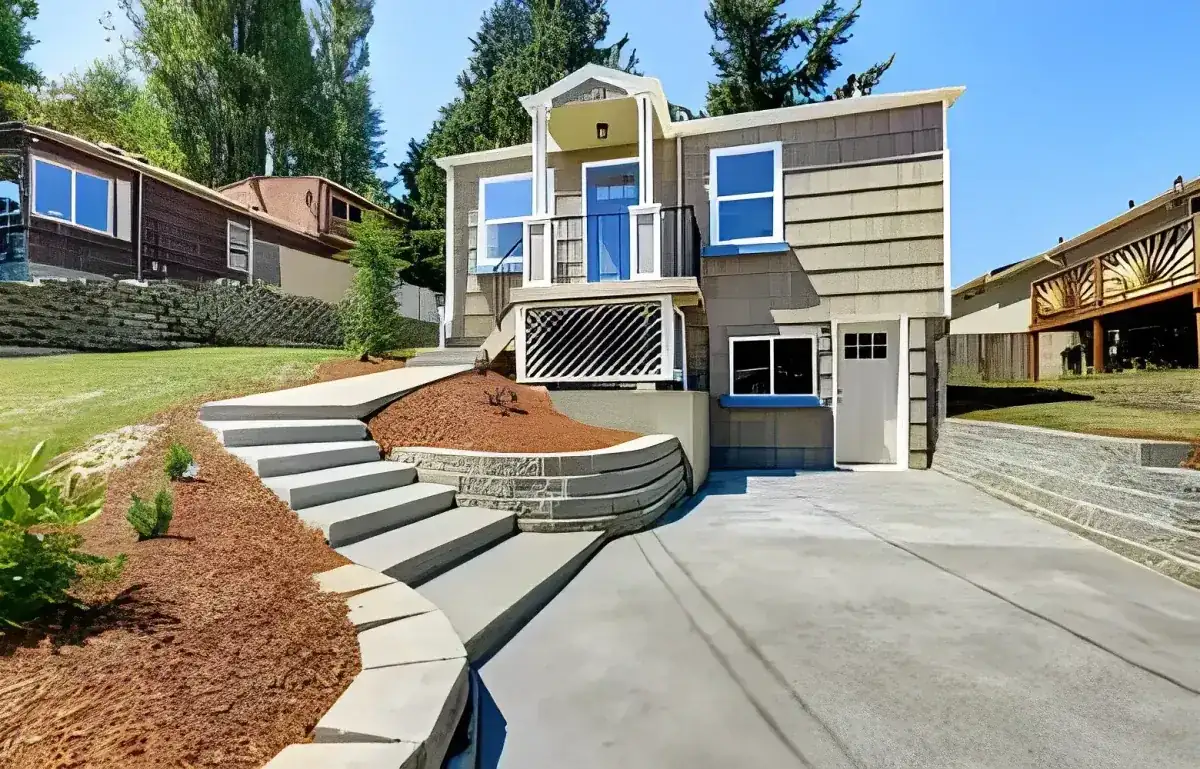
Steel, thickness and strength for concrete driveways: city minimum versus the parking-surface spec
For a driveway on your lot, the floor comes from the city's Residential Construction Information Packet: slab at least 4 inches thick with #3 rebar on 24-inch centers. Once the pour is finished, the packet asks for a tooled or sawed control joint and approved sealant on the construction joint at the driveway-to-approach connection and over the curb. One line in the Engineering Design Manual ends any fiber-only argument: all driveways and walks require reinforcement.
Required parking faces a heavier standard: Zoning Section 13 calls it an all-weather surface and sets a minimum of 5 inches of 3,000 psi concrete at 28 days. The steel is #3 rebar on 18-inch centers both ways, and the subgrade under it is 6 inches compacted to 95 percent standard proctor.
| Item | On-lot driveway minimum | All-weather parking surface | Approach in the right-of-way |
|---|---|---|---|
| Thickness | 4 in. | 5 in. | 8 in. excavation from the street |
| Steel | #3 bar at 24 in. | #3 bar at 18 in. both ways | #3 bar at 12 in. each way on chairs |
| Strength | Written into your estimate | 3,000 psi at 28 days | 4,000 psi at 28 days |
| Subgrade | Stripped and compacted | 6 in. at 95% standard proctor | Inspected by Engineering |
The 2024 IRC became The Colony's code in 2025. That edition calls for 3,000 psi air-entrained mix with 5 to 7 percent air in garage floors, carport slabs and exposed steps. Driveways don't appear in it. So the driveway numbers sit in the city's own manuals instead. Each quote we write also spells out thickness, bar size and spacing, so two bids can be compared side by side.
What It Costs
These are our DFW ranges for reinforced concrete driveways in The Colony. We set the final number after the site visit in a free written estimate, and city permit and application fees are extra.
| Job | Per sq ft | Typical project | What moves the price |
|---|---|---|---|
| 2-car driveway, 4 to 5 in. reinforced, broom finish (400 to 720 sq ft) | $7 to $12 | $3,500 to $8,500 | Access for the truck, approach and curb work, grade changes |
| Heavy-duty 6 in. section for an RV or trailer | Adds $1.50 to $3 | Priced on the estimate | Length of the heavy strip, extra base |
| Tear-out and haul of the old driveway | Adds $1.50 to $4 | Priced on the estimate | Old slab thickness, steel in it, dumpster size |
| Stamped and colored 2-car driveway | $12 to $20 | $8,000 to $13,000 | Pattern, colors, border versus full stamp |
Worked examples: a 20 by 20 single-wide pad is 400 sq ft x $7 to $12 = $2,800 to $4,800. A 24 by 30 two-car driveway is 720 sq ft x $7 to $12 = $5,040 to $8,640, before tear-out or a heavy section. In The Colony, add the $50 flatwork permit and the $50 application fee. To see how these ranges compare across the metro, read our DFW driveway cost guide. Once we've seen the site, a free written estimate makes each figure firm.
Branyon clay, lime heave and the base under concrete driveways in The Colony
Under these slabs, one soil series shows up again and again. Of 30 NRCS sample points inside city limits, Branyon clay turned up at 53 percent. Surface linear extensibility is 9.9 percent there, rising to 13 percent deeper down, and a reading of 9 or more puts soil in the NRCS very high shrink-swell class. The official Branyon series description reports that when the clay dries, cracks 1 to 3 inches wide open to depths of 20 inches or more and stay open 90 to 150 days in most years. On the sloping ground toward Lewisville Lake, the samples found Ferris-Heiden clay instead, with a surface linear extensibility of 17 percent.
Put plainly, the slab sits on ground that swells after rain and sinks in a dry August. First we strip grass and topsoil and compact the subgrade in place. Bars go on chairs so they end up inside the slab and not on the dirt, and we lay out the joints so the concrete cracks where we planned. The city's design manual has its own warning. Lime-induced heaving has caused pavement failures in North Texas, and soil with more than 10,000 ppm of soluble sulfates can't be stabilized with lime. If an engineer specifies lime under yours, ask what the sulfate number is. Our expansive clay guide runs the numbers town by town.
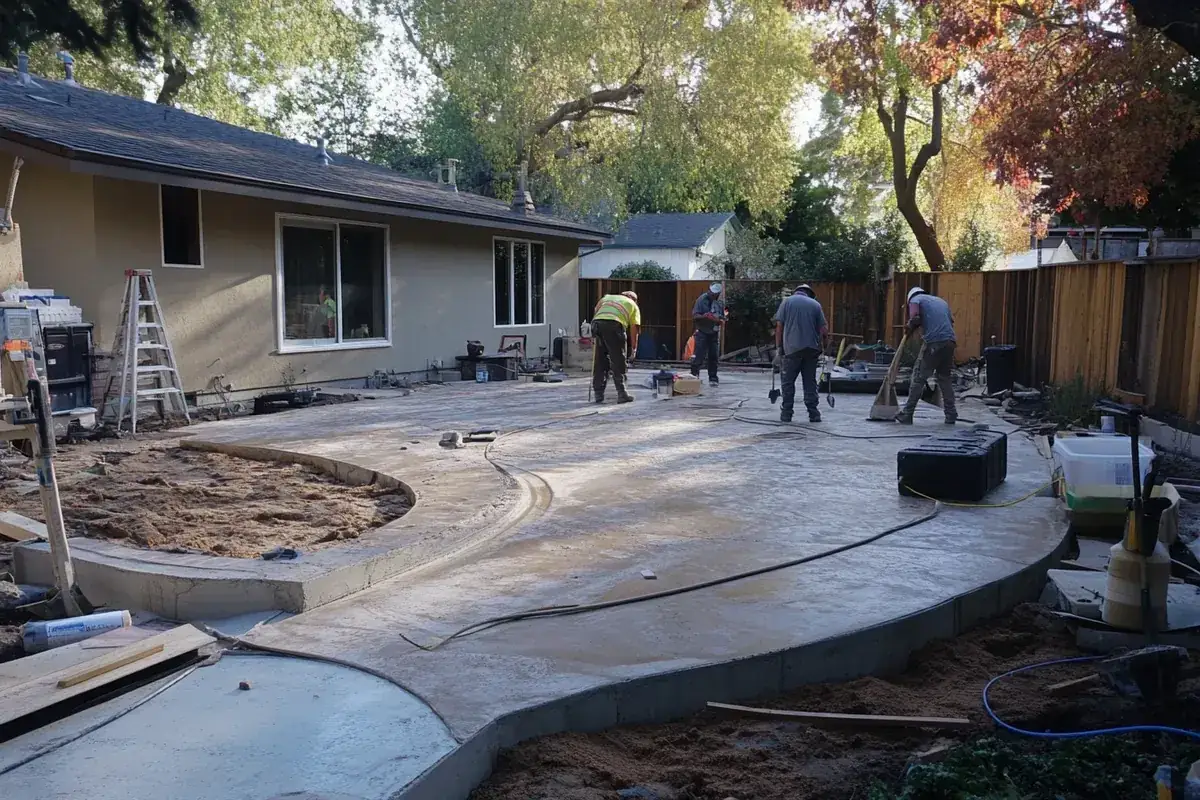
The approach, the curb cut and Engineering's 72-hour window
Inspection in The Colony is split between two offices. The Engineering Department checks driveway approaches and city sidewalks, and Building Inspections only checks sidewalks within 5 feet of the house. The packet lays out the approach step by step. First the existing street and curb get saw cut and removed where the approach ties in. Next comes excavation 8 inches deep from the street through the right-of-way, followed by #3 bars on chairs at 12-inch centers each way.
Along the street edge, #4 smooth dowels are spaced every 24 inches and epoxied at least 6 inches into the existing pavement. A 5-inch plastic cap goes on each free end, and the dowels lap the approach steel by at least 15 inches. The mix is 4,000 psi. Pour timing is strict: the approach has to be poured within 72 hours of the street and curb coming out. Blow that window and the city may ask for a new engineering compaction report, a re-inspection, removal and redo, or an engineer's letter.
To protect the water system, city code also wants 48 hours' notice before a sidewalk or driveway begins. The finished approach must match the engineered design, with the water meter centered in its box and the cleanout brought up or down to grade. If the water meter sits in the approach or driveway, the packet has the general contractor contact Public Works to relocate it. File right-of-way permits online through eTRAKiT. After-hours engineering inspections cost $40 an hour with a two-hour minimum. We hold off booking the curb cut until the truck order and the inspection line up.
How Your Job Goes
Consultation and design
On site we measure the old driveway and mark the approach, meter box and cleanout, then go over width, finish and any extension. The free written estimate that follows lists thickness and steel.
Planning and preparation
Permit and HOA approval come first, then the Texas811 locate, the dumpster and the wash-out station. After that: tear-out, subgrade work, forms, and steel on chairs for inspection.
Installation and completion
The approach and driveway get poured inside the city's 72-hour window. We tool or saw the joints, seal the construction joints and leave the street clean.
Widening concrete driveways in The Colony for a third car: width, flare and frontage limits
Adding front parking in The Colony starts with an extension, the one legal route. The front yard of a single-family, duplex or townhome lot is off limits for parking vehicles, RVs or trailers under City Code Section 19-12, with one exception: the designated front entry driveway. Section 19-1 limits that driveway to 24 feet wide.
Street-side limits come from the residential table in the Engineering Design Manual. On local and collector streets the throat runs 10 to 24 feet wide, with a 5-foot curb radius, meeting the street at 90 degrees. Keep it at least 50 feet from an intersection, and keep the approach grade at 10 percent or flatter. Driveways need at least 20 feet of centerline spacing on a local street and 25 feet on a collector. Width plus radius has to fit within your frontage, between the extended property lines. For arterial streets the table says N/A for residential driveways. Anything touching F.M. 423 (Main Street) or S.H. 121 also needs TxDOT approval, with 200 feet between driveways.
Two rules help you. First, Zoning Section 10B doesn't count driveways or sidewalks as lot coverage, so a widening won't eat into the coverage your lot is allowed. Second, an owner in a larger association whose architectural committee says no has the right to a board hearing under Texas Property Code 209.00505. Our HOA approval guide covers the packet. With the forms already out, it's a good time to add a front walk or a stamped border beside the new pavement.
Pour-day weather for concrete driveways: 100-degree afternoons and the 38-degree rule
DFW Airport sees 106.2 days a year at or above 90 degrees and 20.3 days at or above 100, going by NOAA's 1991 to 2020 normals. July and August highs average 95.6 and 95.8. For the National Ready Mixed Concrete Association, hot weather concreting means high air or concrete temperature, low humidity and wind working together to speed up moisture loss, and fast surface evaporation brings plastic shrinkage cracking. That is why we start summer driveway pours early in the morning.
Cold weather has its own rule. The Colony's packet says no concrete or foundation inspection takes place unless it's at least 38 degrees and rising, or if the inspector finds the site too wet. NRMCA recommends keeping a fresh pour from freezing until it reaches 500 psi, roughly two days after placement. May (4.78 inches) and October (4.37 inches) are the wettest months at DFW, so a spring or fall pour can slip a day or two.
Curling is the other thing to watch on a long run. According to NRMCA's curling bulletin, exterior slabs curl at the edges when the sun-warmed top expands over a cooler subgrade. Thicker slabs curl less, and extra water in the mix raises both drying shrinkage and curling. Tell the driver not to add water at the chute just to make the load flow easier.
Concrete driveways in Frisco, Plano, Lewisville and Allen: what changes
Concrete driveways in The Colony follow one set of rules, and each city line brings a different office, a different code edition and different dirt. Frisco divides the job: its Building Inspections Division handles your lot, Public Works' right-of-way inspectors handle the approach, and inspection requests can't be made by phone. Frisco and Plano enforce the 2024 IRC. Lewisville's Building Services page still lists the 2021 IRC. Our Frisco driveway page and Lewisville driveway page cover those offices.
The soil shifts too. In Plano, NRCS found Houston Black clay at 20 of 30 points, and in Allen at 18 of 30. NRCS rates that series high in shrink-swell. Lewisville looks different: Ferris and Wilson led at 4 of 30 points each, and 6 of 30 points fell on lake water. For those towns, see Plano driveways, Allen driveways and Carrollton driveways. Out in unincorporated Collin County, a driveway connecting to a County road requires a Culvert/Driveway Permit. Residential driveways there are limited to 12 to 20 feet wide, a 5-foot radius and a 14-foot throat depth.
Clearing the old slab for concrete driveways in The Colony: Texas811, dumpsters and the wash-out
Replacing an old slab means digging, so the utility locate has to come first. Contact Texas811 at least two working days before digging. The locate costs nothing, and every digging company needs its own ticket. The planned dig area gets outlined in white paint or flags. Texas811 also notes that private lines you own, such as sprinkler runs to the front beds, aren't marked for free, so show us those at the site visit.
The Colony sets its own site rules for a tear-out. Each job needs a wash-out station. Construction dirt and materials can't sit in the street, and work hours are 7 a.m. to 10 p.m. Roll-off dumpsters have to come from Republic, the city's exclusive solid waste provider; otherwise expect a stop work order and fines. Tear-out is priced at $1.50 to $4 per sq ft more, depending on the old slab's thickness, the steel in it and the length of the haul. Budget for that line in any plan for concrete driveways in The Colony that starts with an old slab.
Common Questions
How thick should concrete driveways in The Colony be?
Do I need a permit to replace my driveway in The Colony?
How long before I can park on a new concrete driveway?
Rebar, wire mesh or fiber for a driveway on clay?
Why do DFW driveways crack, and which cracks are normal?
Can I widen my concrete driveway in The Colony to park a third car?
Do I pay sales tax on a driveway replacement in Texas?
Sources
- Do I Need a Permit? (REV 05/26) (City of The Colony)
- Residential Construction Information Packet (REV03/26) (City of The Colony)
- Engineering Design Manual and Checklists (September 2023) (City of The Colony)
- FY 2026 Master Fee Schedule (City of The Colony)
- Code of Ordinances (Secs. 6-21, 12-111, 19-1, 19-12; Zoning Secs. 10B, 13) (City of The Colony via Municode)
- Branyon Series, Official Soil Series Description (USDA-NRCS)
- CIP 12: Hot Weather Concreting (National Ready Mixed Concrete Association)
- CIP 19: Curling of Concrete Slabs (National Ready Mixed Concrete Association)
- FAQ (Texas811)
- Real Property Repair and Remodeling (Publication 94-116) (Texas Comptroller of Public Accounts)