
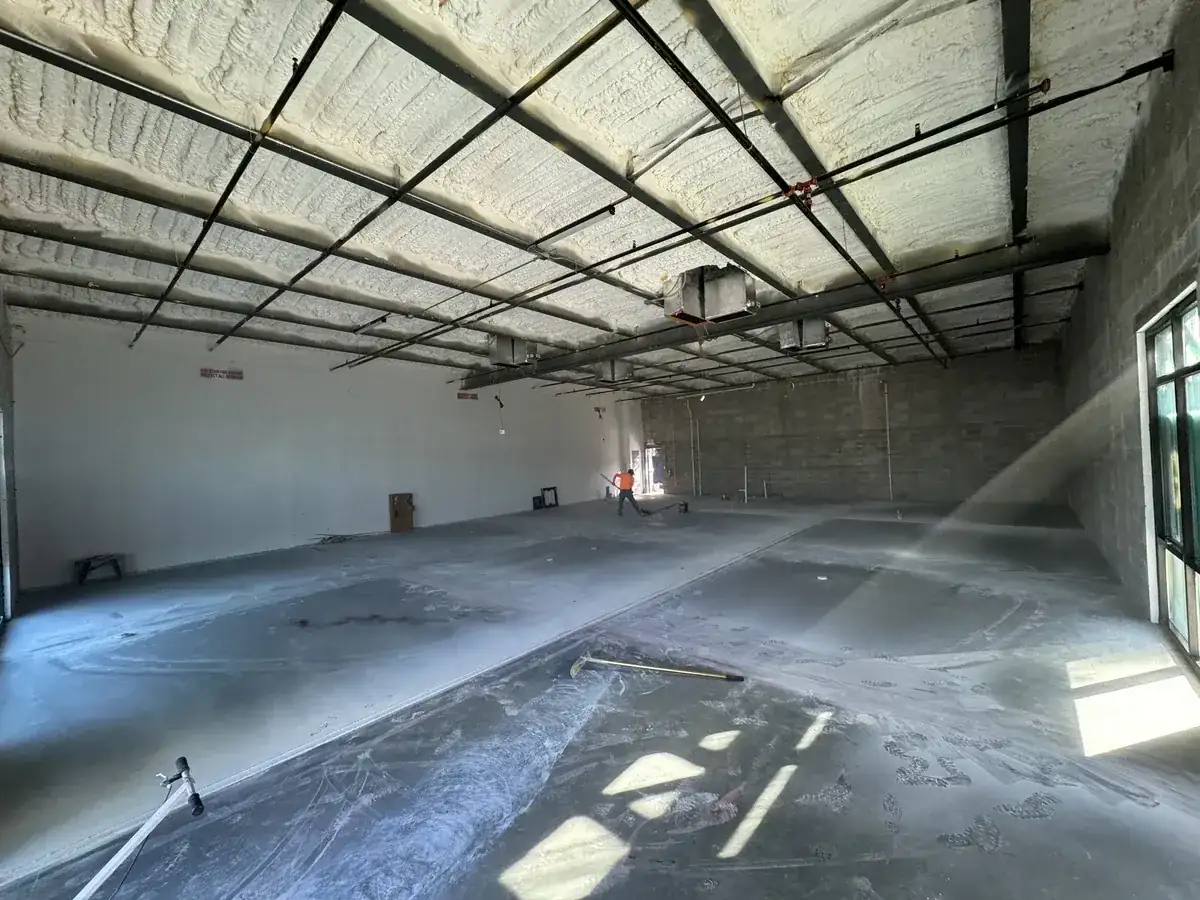
Shed pads, shop floors and equipment slabs: the concrete slabs we pour in The Colony
Nothing we pour is simpler than a slab, and nothing is easier to get wrong, since what sits on it decides the size, thickness and steel. Covered here: pads for prefab storage sheds and greenhouses, detached shop and garage slabs, RV and boat pads, hot tub and generator pads, plus one-offs like a dog run or a basketball half court. Each is a reinforced concrete slab over a compacted base, sized for the building or the load.
Once a slab carries a framed building with bearing walls, or ties into the house, it may become engineered foundation work, which our foundations page covers. Replacing the floor inside an existing garage? See garage floors. All the rest, whether a 10x12 shed pad or a 30x40 shop slab, is priced below.
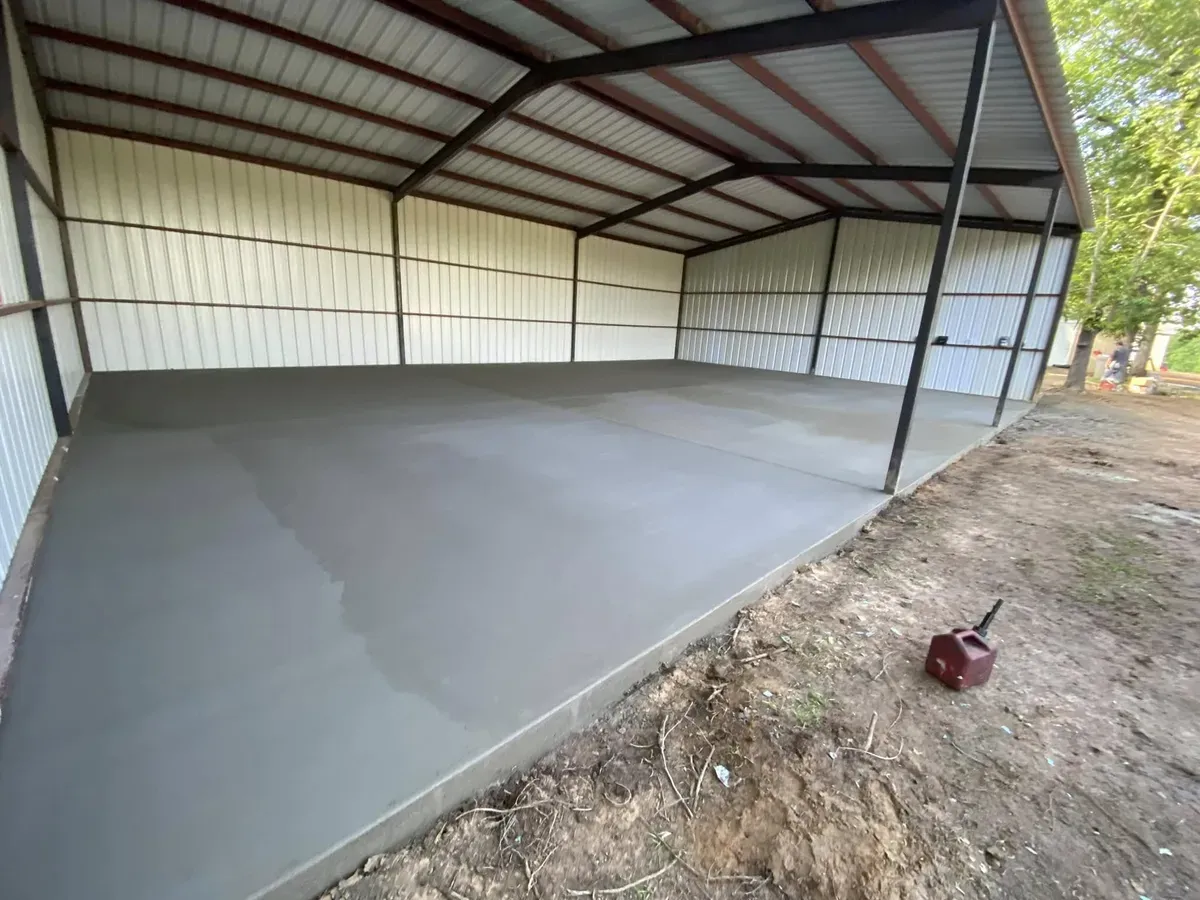
How thick, how strong and how much steel for concrete slabs in The Colony
Think of the residential code as a floor, not a target. A concrete slab-on-ground floor must be at least 3 1/2 inches thick under IRC R506.1, which also points to the expansive-soil rules for clay like ours (IRC chapter 5). Each city picks a weathering class, and strength follows from Table R402.2; The Colony picked Moderate. Under it, garage floor slabs, carport slabs, and porches and steps exposed to the weather need at least 3,000 psi with 5 to 7 percent entrained air, while interior slabs-on-grade can be 2,500 psi (IRC chapter 4).
Bar size counts, but so does bar position. Reinforcement, where a slab has it, has to be supported so it stays between the center and the upper third of the slab for the entire pour. A bar trodden into the dirt by the crew does almost nothing.
Our sizing goes like this. Garden-storage shed pads get 4 inches with rebar on chairs. Where a car, a lift or a loaded trailer will sit, a shop or garage slab runs 4 to 6 inches, reinforced, with thickened edges under the walls. Required parking is covered by The Colony's zoning code, which calls an all-weather surface at least 5 inches of 3,000 psi concrete with No. 3 rebar at 18 inches both ways over 6 inches of subgrade compacted to 95 percent standard proctor. We start there for any RV or boat pad and add for heavier loads.
What It Costs
At 4 to 6 inches, reinforced slabs and pads run $7 to $12 per sq ft, and a 24x30 garage or shop slab comes to $5,500 to $9,000.
| Job | Per sq ft | Typical project | What moves the price |
|---|---|---|---|
| 10x12 shed pad | $7 to $12 | $1,000 to $1,700 | Access for the truck or a pump, leveling a sloped yard |
| 12x16 shed or greenhouse pad (192 sq ft) | $7 to $12 | $1,344 to $2,304 | Thickened edges, distance from the street |
| 24x30 garage or shop slab | $7 to $12 | $5,500 to $9,000 | Thickness (4 to 6 in.), steel, edge beams, permit plans |
| 30x40 shop slab | $7 to $12 | $10,000 to $17,000 | Fill depth, base course, lift or trailer loads |
| Engineered shop slab | $12 to $20 | Quoted per plan | Engineer's beam and steel schedule |
Use these ranges for planning. After we see the spot, check the grade and confirm what the city requires for your building, you get a free written estimate for your concrete slab in The Colony.
Base, fill and moisture under concrete slabs on Branyon clay
Site prep rules in the code are brief, and we follow them to the letter. Under IRC R506, vegetation, topsoil and debris come off, any fill is compacted for uniform support, fill stays at no more than 24 inches of clean sand or gravel or 8 inches of earth unless approved, and where the slab is below grade a 4-inch base course of clean graded sand, gravel or crushed stone goes on the subgrade. The exception is well-drained or sand-gravel Group I soil, and the Blackland clays under The Colony are not that soil.
More than half of 30 random points inside the city sit on Branyon clay, per NRCS data, with very high shrink-swell, and NRCS rates 24 of the 30 points Very limited for dwellings on concrete slab. The city's engineering manual adds a warning: lime-induced heave has failed pavements in North Texas, and the manual rules out lime stabilization once soluble sulfates pass 10,000 ppm. We don't lime a pad base until we know what is in the soil.
The code decides the vapor retarder question for you. 6-mil polyethylene goes under slabs in the 2024 IRC, with exemptions for garages, utility buildings and other unheated accessory structures, carports, and flatwork not likely to be enclosed and heated later. A storage shed pad is exempt. A shop you may air condition and finish someday is not, so share your long-range plan with us. The full picture on clay is in our expansive clay guide.
The Colony's accessory building rules that set your slab size
Before you choose a slab size, find out what the city allows on your lot. According to the storage building and greenhouse handout, a permit is needed for buildings over 120 sq ft and/or 8 ft high, which must sit 3 ft from the house and all property lines, and foundation plans need an engineer's seal if applicable. The same handout keeps storage buildings out of the required front yard setback and out of platted or recorded easements, and one in a side yard must be screened from public view by an 8 ft wood fence, masonry wall or evergreen hedge. In HOA areas the permit comes with an HOA approval letter. The city's patio and deck handout says any structures and foundations of 400 sq ft or greater and/or attached to the house must have engineered plans.
Size caps follow. The house and accessory structures together cannot top 40 percent lot coverage, a detached building's footprint cannot exceed half the house footprint, and the height limit is 16 ft or the house height, whichever is less. Planned developments have their own numbers. The city's PD setback table shows 50 percent coverage for most single-family tracts in Ridgepointe (East), Stewart Peninsula and The Legends, 40 percent in Ridgepointe (West), and lists carports as prohibited in Austin Ranch.
Lots that back onto Corps of Engineers property at Lewisville Lake need a separate permit from the Lake Manager's Office, submitted with the city application. For fees, a residential accessory structure permit is $0.159 per sq ft with a $50 minimum on the FY 2026 schedule. We locate your concrete slab in The Colony where the rules permit and pull the permit with the plans you need.
How Your Job Goes
Consultation and design
On site we measure the spot against setbacks and easements, ask what will sit on the slab, and settle thickness, steel and edges.
Planning and preparation
Permit and locates come first. Then we strip and grade the pad, compact the subgrade, lay the base course and set steel on chairs.
Installation and completion
The pour, finish and joints come next, then we keep the slab moist and blocked off while it gains strength. The site is left clean and the pad ready for the building.
Shed permit thresholds near concrete slabs in The Colony
The model code exempts small sheds, but the cities around us have cut that exemption down. If your lot is outside The Colony, the table shows where the line falls:
| City | Permit needed for an accessory building | Placement rules |
|---|---|---|
| Carrollton | Over 120 sq ft (the model code's 200 sq ft is struck) | One accessory building plus one detached garage per lot; not between the house front and a street; over 600 sq ft must match the house |
| Plano | Over 120 sq ft | See the city's accessory building brochure |
| Allen | Over 120 sq ft | Exemption void if the shed sits in a private drainage easement |
| Lewisville | Over 120 sq ft | 5 ft from side and rear lines and the house; none in an easement; size caps by lot size (handout) |
| Little Elm | Over 200 sq ft | 3 ft from fences and property lines; 750 sq ft cap on lots under 1/2 acre |
| Frisco | All accessory structures | Permit before placement or construction |
| Prosper | All accessory buildings, any size | Patio covers, pergolas and arbors need permits too |
Pour day, curing and paperwork for bigger concrete slabs in The Colony
Fresh slabs have a hard time in North Texas summers. DFW Airport normals show July and August highs near 96 degrees and about 106 days a year at 90 or above. NRMCA's hot weather guide says heat, low humidity and wind draw water out of the surface fast and can cause plastic shrinkage cracks. Big summer pours start at first light with us, and we keep the slab wet and cut joints the same day. Winter has its own rule: fresh concrete has to be kept from freezing until it reaches about 500 psi, around two days, and the city won't inspect unless it is at least 38 degrees and rising. Edges curl less on thicker slabs, another reason not to skimp on a shop floor.
The Colony's site rules call for a concrete wash-out station, no dirt or materials left in the street, and work hours of 7 a.m. to 10 p.m. Every dig starts with a utility locate, and our permit guide covers Texas811 and the city steps for concrete slabs in The Colony.
A note on paperwork for larger jobs. Slabs of 24x30 or 30x40 can pass $5,000, and under Texas Property Code 162.006 a contractor with a written contract to improve a homestead for more than $5,000 must hold the money in what the bank calls a construction account (statute). Sign a written contract before work starts on any concrete slab in The Colony, and ask in writing for that account.
Common Questions
How thick should a shed slab be?
Do I need a permit for concrete slabs in The Colony that hold a shed?
What is a monolithic slab?
Can I put an RV pad beside my house in The Colony?
Does a shop slab need a vapor barrier?
Can you pour a slab on a lot that backs onto Lewisville Lake?
How soon can I set a shed on a new pad?
Sources
- Storage Building and/or Greenhouse Requirements (REV 5/26) (City of The Colony)
- Patio Deck and Patio Cover Requirements 2026 (City of The Colony)
- 2024 International Residential Code, Chapter 5 Floors (International Code Council)
- 2024 International Residential Code, Chapter 4 Foundations (International Code Council)
- Code of Ordinances (Sec. 6-1, 19-12, Zoning Sec. 13) (City of The Colony via Municode)
- PD Setbacks and Lot Coverage (Revised 01/2025) (City of The Colony)
- CIP 12: Hot Weather Concreting (National Ready Mixed Concrete Association)
- Texas Property Code Sec. 162.006 (Texas Legislature)