
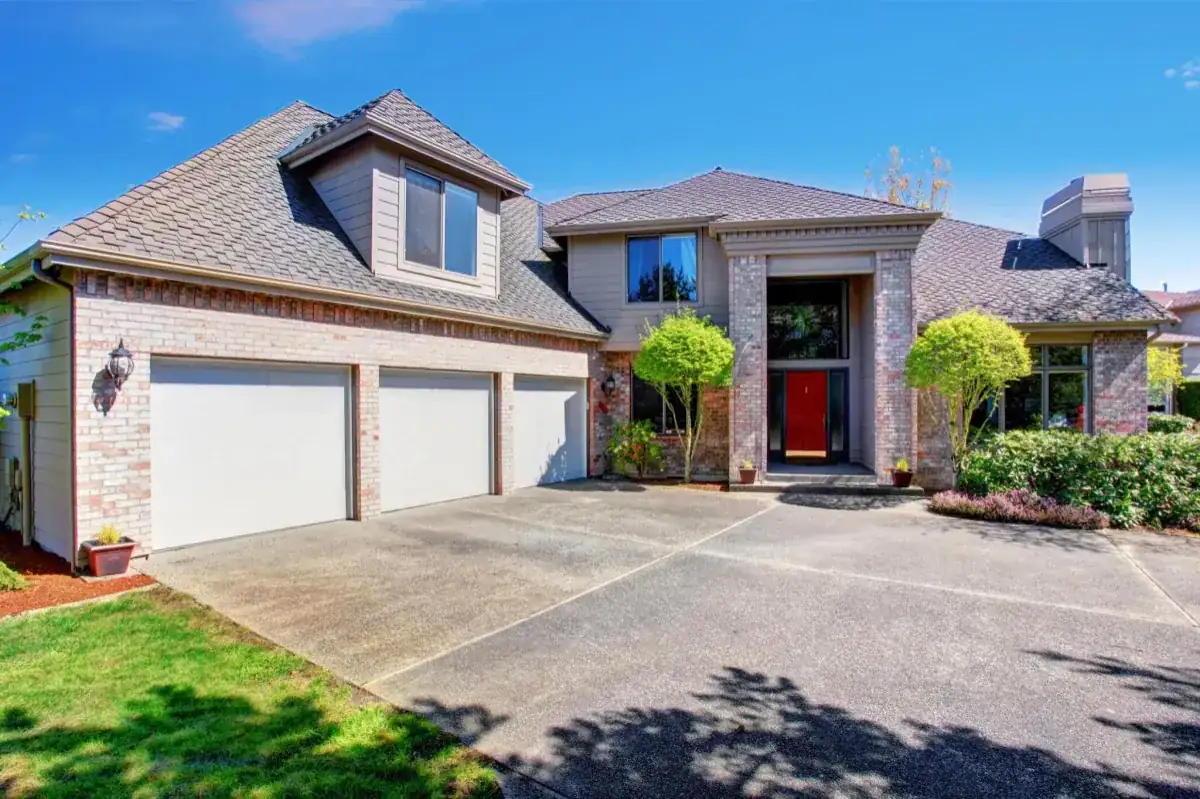
Grapevine at a glance
Grapevine lies in northeastern Tarrant County, with small sections in Dallas and Denton Counties. Grapevine Lake reaches from the north side of the city into Denton County, a sizable part of DFW International Airport lies inside city limits, and the historic districts include the Main Street commercial district.
The ground is mixed: Crosstell and Gasil fine sandy loams with low shrink-swell sit beside pockets of Heiden and Houston Black clay near 12 percent LEP. One in five NRCS sample points landed on lake water, and 30 percent fell in FEMA Zone AE.
Permit office: City of Grapevine Building Inspections (City Walks and Approaches permit for right-of-way work) · official page Private driveways and sidewalks are exempt from a building permit if zoning rules are met; approaches and public sidewalks need the $15 Walks and Approaches permit.
Concrete Contractor in Grapevine: Private Drives Skip the Building Permit, Approaches Do Not
The city's amendment to IRC R105.2 exempts "sidewalks and driveways" from a building permit, with one condition: the zoning ordinance's rules on required materials, maximum coverage and required landscaping still apply. Once the work reaches the right-of-way, the picture changes. An approach or a sidewalk in the public strip takes a City Walks and Approaches permit, at $15 per approach and $15 for new sidewalk, plus a $30 re-inspection fee. The application wants two copies of a dimensioned plot plan. It must show where the approach sits and how far it is from street or alley intersections, the width at the property line, the radius on both sides, whether curb and gutter exist, and the sidewalk's path. Engineering signs off before the permit is approved. When the approach is built with a new house under a current building permit, no separate fee applies. Our north Dallas suburbs permit guide compares the rules with nearby cities.
Reading Detail GR2150 Before the Saw Cut
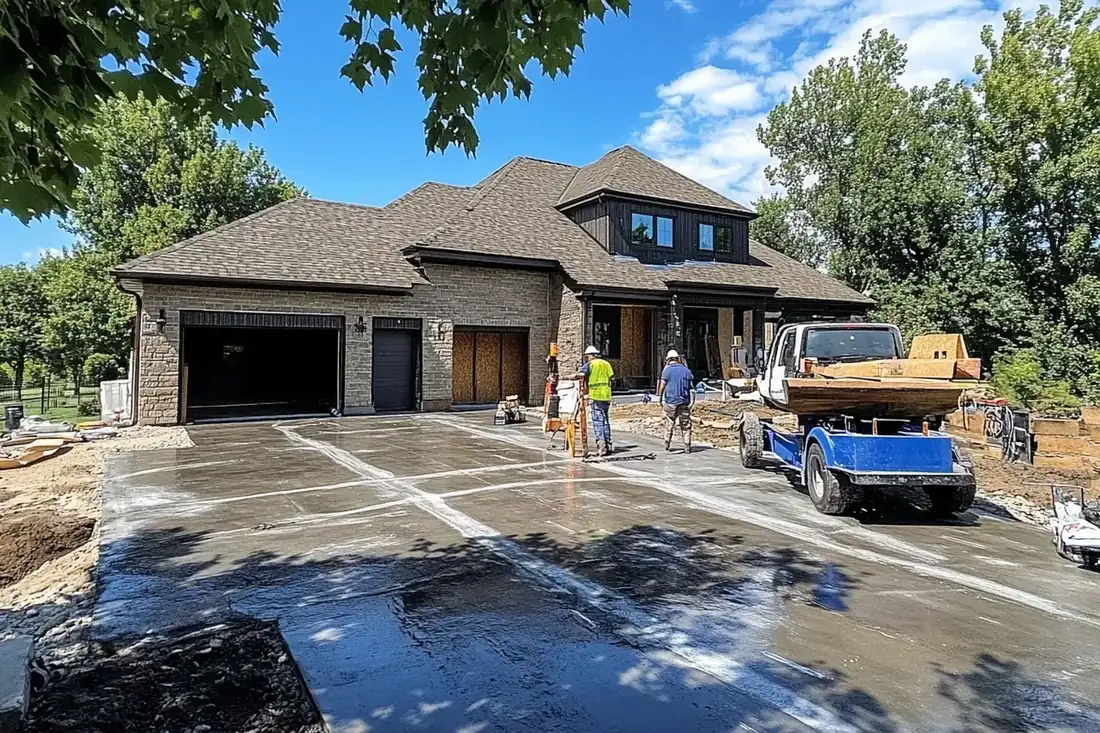
Standard detail GR2150 is how the city's Public Works department draws the residential driveway approach, and it is a heavier build than the slab you might picture. The construction details sheet requires:
- A section at least 6 inches thick, in 3,600 psi concrete.
- #4 bars at 18 inches both ways.
- A 5 foot minimum radius on each side, with a #4 bar bent to a radius 4 inches larger than the curb radius.
- A redwood header at the right-of-way line.
- #4 bars 18 inches long, doweled and epoxied into a concrete street, or full-depth asphalt fill where the street is asphalt.
- Section joints with #4 by 24 inch smooth dowels and either 1/2 inch pre-formed expansion material or 3/4 inch redwood.
Residential sidewalks on the same sheet are at least 4 feet wide. Past the header, your concrete driveway is a private slab. Its thickness, steel and joint spacing depend on the ground and the load, and we put those in the estimate. Any concrete contractor in Grapevine should show you both parts of the build.
What It Costs
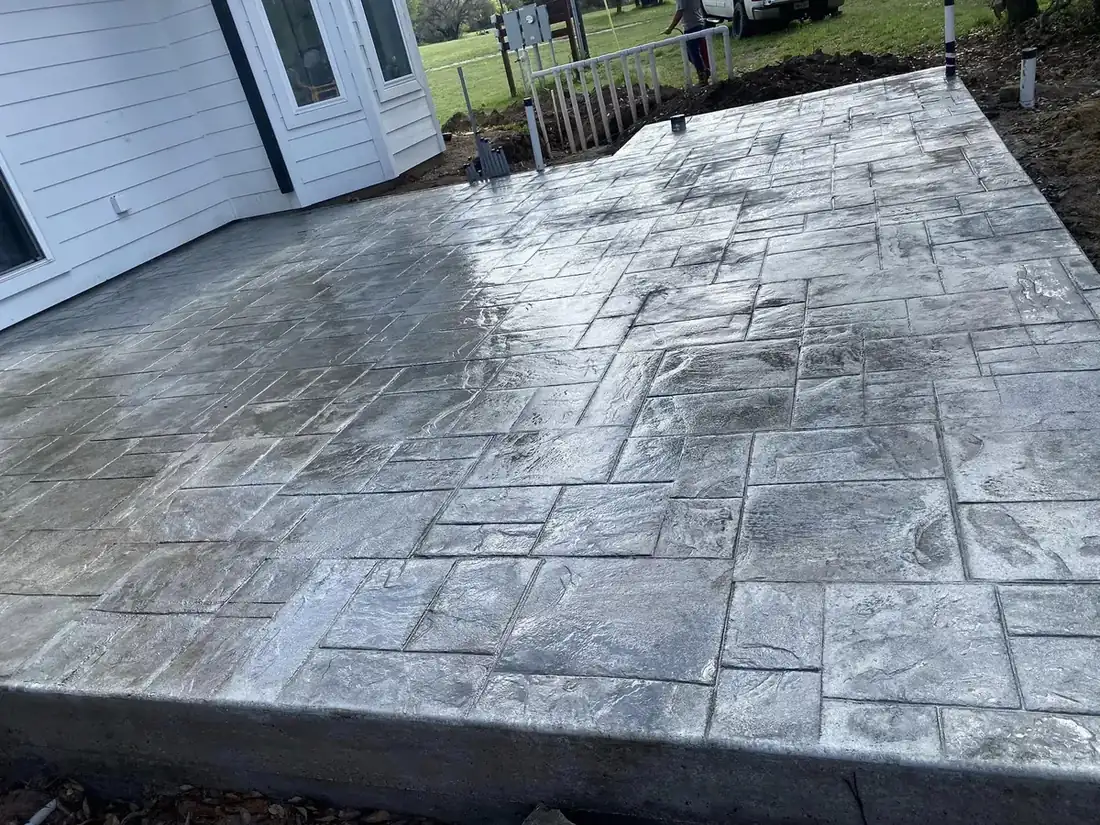
Installed ranges from a concrete contractor in Grapevine, all reinforced concrete.
| Job | Per sq ft | Typical project | What moves it here |
|---|---|---|---|
| Driveway replacement | $7 to $12 | $3,500 to $8,500 | Tear-out, the GR2150 approach at the curb, sandy loam vs clay base |
| Patio | $7 to $12 | $2,000 to $5,000 | Zoning coverage and landscaping rules, drainage toward neighbors |
| Shed or shop slab | $7 to $12 | $5,500 to $9,000 | Size; sheds up to 120 sq ft need a permit but no fee |
| Addition foundation | $8 to $14 | Per engineer's plan | PE-sealed design required for any size addition |
Ranges, not a bid. A free written estimate follows once we have seen the site.
Main Street, College Street and the Other Historic Districts
In 1991 the city adopted a Historic Preservation Ordinance, and the Historic Preservation Commission now watches over the Historic Grapevine Township District, five local districts and individual landmarks. The district list includes the Commercial (Main Street) district, College Street, Cotton Belt Railroad, West Wall Street and the D. E. Box Addition. An exterior change inside a district needs a Certificate of Appropriateness, judged against the district's design guidelines.
The site design guidelines say plenty about concrete. In the residential historic district, driveways run perpendicular to the street, circular drives are barred from front and corner side yards, and off-street parking may not cut up a landscaped front yard. Low stone walls are welcome in side and rear yards, concrete can show on retaining walls at property lines, and the raised sidewalks along Main Street stay. The Commission meets on the fourth Wednesday of every month at City Hall, with completed applications due 60 days ahead, so build that lead time into a district driveway job. Check with the Historic Preservation Officer early to learn if your work needs a certificate.
Sandy Loam, Clay Pockets and the Grapevine Lake Shoreline
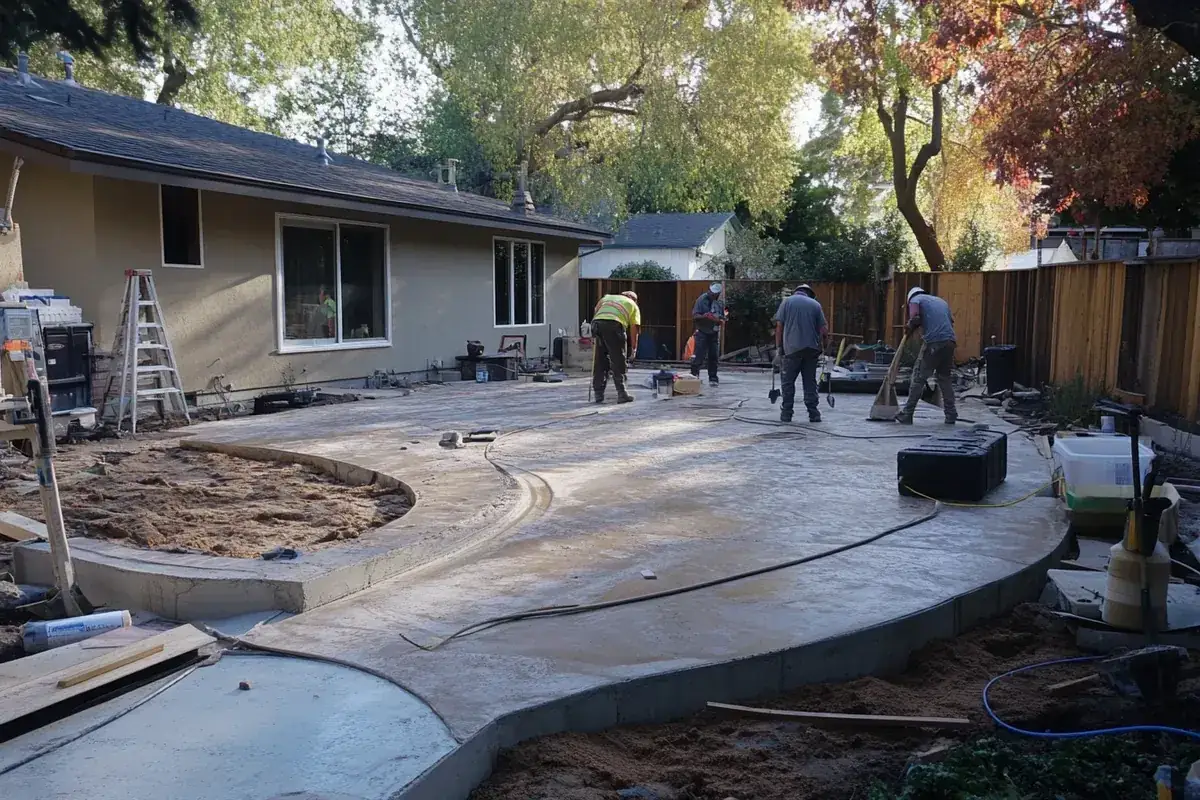
The city sits on the edge of the Grapevine Prairie and the Eastern Cross Timbers, north of the West Fork of the Trinity River, and the ground varies. NRCS soil records for 30 random points inside the city limits put 6 on the open water of Grapevine Lake. Of the 24 land points, Crosstell fine sandy loam came up most often. Its linear extensibility is only 0.8 percent, but NRCS still rates it very limited for house slabs. Gasil fine sandy loam also sampled low. Pockets of Heiden clay and Houston Black clay, both near 12 percent LEP, follow, and a quarter of the land points reached 9 percent or more. Lots a few streets apart can need different base work, so a concrete contractor in Grapevine has to look at the dirt before pricing. Our guide to expansive clay and slabs explains what a high LEP does to a slab.
Water is the other half of the story. The Corps of Engineers started Grapevine Dam in 1948 and completed the lake in 1952, and FEMA's map put 30 percent of those same sample points in Zone AE. City Engineering handles the floodplain and the Master Drainage Plan. The city's Lot to Lot Drainage Program, created in 1994, has a Drainage Inspector who reviews building plans and helps settle private drainage disputes between lots.
Engineered Foundations for Any Size Addition
Under the city's amendment to IRC R401.2, a Texas-registered Professional Engineer must design, sign and seal the foundation of any dwelling unit, and of any size addition to an existing foundation. Buildings accessory to a house and not used as dwellings are exempt. That puts an engineer's plan behind a 12 by 16 sunroom slab, and we pour concrete foundations to that plan, not to a rule of thumb, as every concrete contractor in Grapevine must on an addition. Detached sheds and playhouses up to 120 sq ft still need a permit but carry no fee, which matters if you want a shed slab poured first.
For planning, the city aims at 5 to 7 business days for residential storage buildings and fences, and 7 to 10 business days for new homes, additions and remodels. Contractors register through the OpenGov portal or on a paper form with a $75 fee. The city fee sheet bills additions and alterations to an R-3 dwelling at $1.00 per sq ft, and the lot drainage fee for a single-family home is $150.
Replacing Grapevine Driveways From the 1980s Building Boom
The city went from 7,023 people in 1970 to 29,198 in 1990, and its housing reflects that: 29 percent of homes date from the 1980s, and the median home was built in 1993. A driveway poured alongside a 1985 house is now around 40 years old. At that age we look for settled panels, root heave and worn joints when we price a replacement.
Here is a budget example. A 20 by 22 two-car driveway is 440 sq ft, and at our $7 to $12 per sq ft that comes to $3,080 to $5,280, while tearing out the old slab adds $1.50 to $4 per sq ft and a 6 inch heavy-duty section for a truck or trailer adds $1.50 to $3 per sq ft. When the approach comes out as well, the GR2150 spec and the $15 permit join the job. The DFW driveway cost guide itemizes the rest. For your own lot, a concrete contractor in Grapevine can put numbers on it with a free written estimate.
Common Questions
Does a concrete contractor in Grapevine need a building permit to replace a private driveway?
What does Grapevine charge for a driveway approach permit?
Can I add a circular driveway to a house in a Grapevine historic district?
Why does a room addition in Grapevine need an engineer for the slab?
Is Grapevine on the 2024 building code yet?
Who helps if a neighbor's new patio sends water onto my Grapevine lot?
Sources
- Building Code Information (City of Grapevine)
- Residential Code Amendment (2021 IRC) (City of Grapevine)
- City Walks and Approaches Permit Application (City of Grapevine)
- Public Works Construction Details (GR2150) (City of Grapevine)
- Design Guidelines 3.7 (site design) (City of Grapevine)
- Grapevine Historic Districts (City of Grapevine)
- Lot to Lot Drainage (City of Grapevine)
- Grapevine, TX (Tarrant County) (Texas State Historical Association, Handbook of Texas)